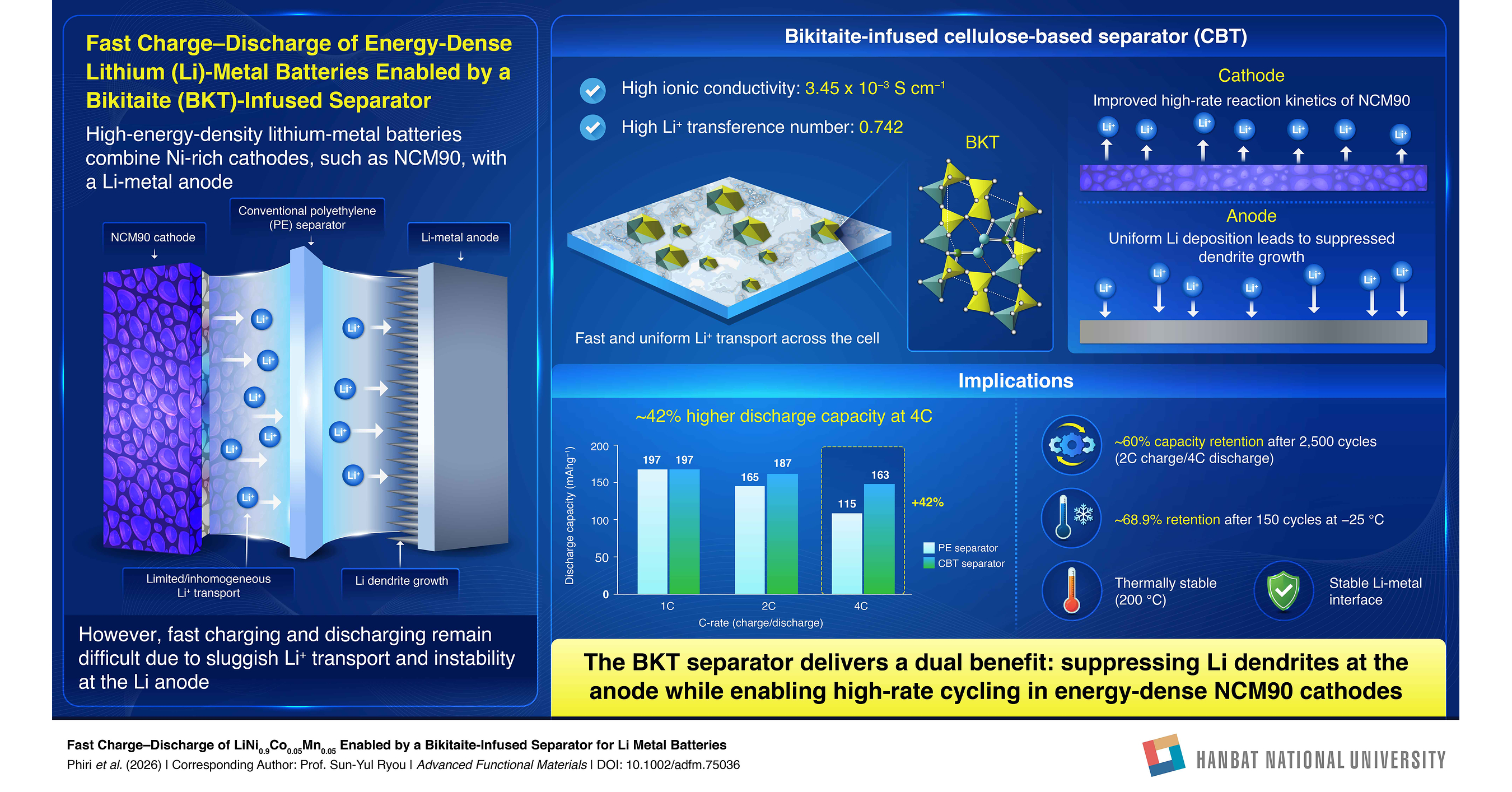
The research team, led by Professor Sun-Yul Ryou, designed the bikitaite-infused separator—dubbed CBT—to create interconnected pathways for lithium-ion movement. By combining the natural porosity of cellulose with the specific ion-transport properties of bikitaite, the separator achieves an ionic conductivity of 3.45 × 10⁻³ S cm⁻¹ and a transference number of 0.742. These physical characteristics significantly reduce polarization, allowing the NCM90 cathode to maintain higher capacity under demanding discharge rates.
Performance tests highlight the disparity between the CBT separator and conventional polyethylene alternatives. While both separators performed similarly at 1C, the gap widened as rates increased. At 4C, cells utilizing the CBT separator delivered 163 mAh g⁻¹, compared to just 115 mAh g⁻¹ for standard separators—an improvement of roughly 42%. Beyond cathode efficiency, the separator successfully suppressed visible dendrite growth, ensuring the lithium-metal anode formed a smooth, compact layer during cycling.
The findings, published in Advanced Functional Materials, suggest a shift in battery design strategy. Rather than focusing solely on costly electrode material redesigns, engineers can leverage the separator as an active component to manage ion flux. The CBT separator maintained 60% capacity after 2,500 cycles and demonstrated thermal resilience at 200 °C. Because this modification integrates into existing manufacturing lines, it offers a scalable pathway for enhancing next-generation battery performance.
Comments (0)
No comments yet. Be the first!